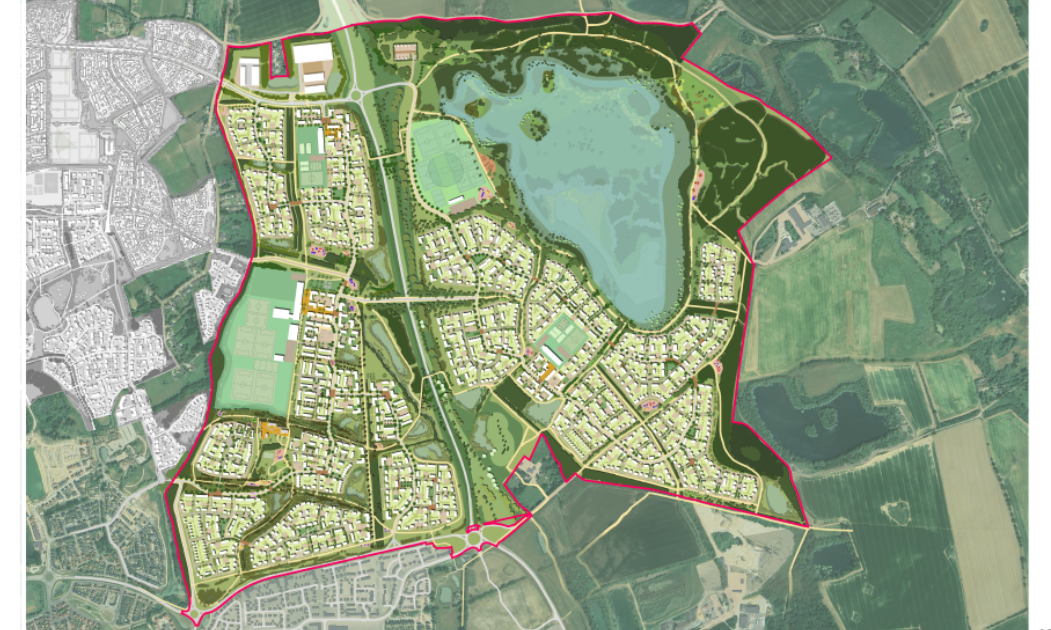
Plans for the next major phase of Chelmsford Garden Community have moved forward after Chelmsford City Council’s Planning Committee resolved to approve the final outline planning application.
The decision clears the way for three new villages containing 3,500 homes, including at least 665 affordable properties.
The development will also provide new schools, community facilities, employment space, sports provision, parks, walking and cycling routes, and improved public transport connections.
The approved plans cover the new villages of Hawthorn, Park Farm and Willow Hill, which will form part of a wider connected community in north-east Chelmsford.
What will Chelmsford Garden Community include?
The latest phase of Chelmsford Garden Community is expected to provide:
3,500 new homes
At least 665 affordable homes
Two new primary schools
An all-through school with nursery, primary and secondary education
Potential future sixth-form provision
A 104-hectare destination country park and lake
More than seven hectares of sports facilities
Village centres with shops, cafés and community spaces
Flexible offices, business hubs and co-working areas
Healthcare and childcare facilities
New bus, walking and cycling connections
The plans form part of a long-term programme of sustainable growth expected to develop over the next 20 years.
They build on earlier approvals for Zones 1 and 3 and on established neighbourhoods such as the award-winning Beaulieu development.
Councillor Richard Lee, Chelmsford City Council’s Cabinet Member for Planning and Place-Shaping, said:
“This approval is a fantastic step forward for Chelmsford Garden Community and for the people who will eventually live in and around it.
“It means we can move ahead with well-planned neighbourhoods that bring new homes, schools, green spaces, local facilities and better connections together from the very beginning.
“The focus has always been on creating places where residents can put down roots, access everyday services close to home and enjoy a strong sense of community.”
Three new villages planned for north-east Chelmsford
Each of the three villages will have its own identity while remaining connected to the wider Garden Community.
Park Farm
Park Farm will become the civic centre of the development.
It will include a pedestrian square surrounded by community facilities, shops, cafés and an all-through school. It will also sit beside Park Farm Meadows, a new destination play park.
The village is expected to provide 1,259 homes.
Planned facilities include:
An all-through school with nursery, primary and secondary provision
Potential future sixth-form accommodation
A healthcare facility
A community centre
A stewardship office
Retail and commercial space
Co-working facilities
A mobility hub
Willow Hill
Willow Hill will be designed around the area’s historic field patterns, with green corridors, tree-lined streets and buildings inspired by traditional farmsteads.
An employment hub will provide space for businesses and support more opportunities for people to work close to home.
The village is expected to contain 563 homes.
Planned facilities include:
A primary school
A day nursery
Willow Hill Employment Hub
Co-working space
Retail units
Flexible community space
A mobility hub
Hawthorn
Hawthorn will be the largest of the three villages, with 1,678 homes.
It will sit beside Dukes Wood Nature Park and feature lower-density housing, softer development edges and easy access to the surrounding countryside.
Historic wartime buildings within the area could also be retained and brought back into use as distinctive local landmarks.
Planned facilities include:
A primary school
Nursery accommodation
Local shops
Flexible employment and co-working space
Community facilities
Dukes Wood Sports Hub
A mobility hub
Walkable neighbourhoods with services close to home
The villages have been designed around walkable-neighbourhood principles, with schools, shops, green spaces and community facilities positioned close to new homes.
Walking, cycling and bus routes will connect residential areas with the village centres and the wider Chelmsford area.
Most homes are expected to be within 400 metres of a bus stop.
Bus services will link the development with locations including Beaulieu Park Station and Chelmsford city centre. The service network is expected to receive funding for its first 10 years while passenger numbers grow towards long-term commercial viability.
Mobility hubs in each village will support different forms of transport and make it easier for residents to travel without relying entirely on private cars.
Parks, wetlands and wildlife habitats
Nature is a central part of the Chelmsford Garden Community plans.
Around 130 hectares—more than half of the site—will be dedicated to green and blue infrastructure, including:
Parks
Woodland
Wetlands
Lakes
Landscaped corridors
Play areas
Tree-lined walking and cycling routes
Dukes Wood Nature Park and Park Farm Meadows will provide major recreational spaces for residents and visitors.
New planting, wetlands and connected wildlife corridors are intended to support biodiversity and nature recovery.
Discovery trails and circular walking routes will also help people explore the area’s natural landscape and local history.
Roads and transport infrastructure planned alongside new homes
The development will follow an infrastructure-first approach, with roads, public transport, active travel routes and community facilities planned alongside housing.
A key part of the transport network will be the Chelmsford North East Bypass, which will run north to south through Zone 2.
The Northern Radial Distributor Road will connect the bypass with Essex Regiment Way through Willow Hill.
New access from Beaulieu Parkway will prioritise buses, while two active-travel bridges and a new road bridge will cross the bypass to maintain connections between Hawthorn and the rest of the development.
New junctions, pedestrian crossings, cycle routes and walking paths will also be delivered as part of the coordinated infrastructure programme.
Councillor Russell Quirk, Deputy Leader of Essex County Council, said:
“At the very heart of Chelmsford Garden Community is the County Council’s commitment to making sure everyone can get to wherever they need to be—for work, school, friends, family and leisure—as quickly and easily as possible.
“This is going to happen because we are putting the right roads and infrastructure in place.
“Upgrading the A12 junction and the station access roundabout will help the Garden Community grow and benefit residents old and new.”
Employment opportunities within the new development
The plans aim to support one job for every new home created within Chelmsford Garden Community.
Employment space will range from larger business hubs to smaller offices and flexible co-working areas.
By providing workplaces within the villages, the development aims to reduce the need for longer journeys and give residents more opportunities to work closer to home.
Village centres will also provide space for shops, cafés, healthcare services and community organisations.
Who is delivering Chelmsford Garden Community?
Chelmsford Garden Community is being delivered by a consortium that includes Ptarmigan Land, Halley Developments and Countryside L&Q North-East Chelmsford.
Chelmsford City Council is overseeing the wider vision in partnership with Essex County Council, Homes England and Chelmsford Garden Community Council.
A legal agreement will support a coordinated approach across the different developers and phases of construction.
The wider project is guided by an agreed masterplan and Garden City principles, with a focus on sustainability, community involvement, green space and connectivity.
The aim is to create established neighbourhoods where people can access homes, education, employment, transport and everyday services within a well-connected part of Chelmsford.